Guide 03

Why your cushion comes before your down payment

The one month that undoes six, and the small pile of money that stops it.

5 minute read

Every dollar toward the house. It's the strategy almost everyone starts with, because it feels like commitment and because a cushion sounds like a detour. You'll build a cushion later, once the house is sorted. Right now, the house.

Then the car makes a noise.

What does one repair actually cost you?

Take the example climb on this site. A $36,000 summit, split into forty switchbacks of $900 a month. The member has been logging around $850 a month and has cleared seven switchbacks. Now the car needs $650 of work, and there is no cushion, so the $650 comes out of the house money.

The immediate cost is $650. The real cost is bigger. That withdrawal takes the running total from just past switchback 7 back below it, and depending on where the month lands, it can undo two switchbacks in one afternoon. The summit date, which is what's left divided by your pace, slides later by about a month. And the next paycheck, the one that would have cleared switchback 8, goes to refilling the hole instead.

None of that is dramatic. It's just a month gone, and the month after it half gone. Do it three times in a year, which is about how often ordinary life sends a bill you didn't plan for, and you've lost most of a season without a single bad decision.

Why does it feel worse than the arithmetic?

Because the arithmetic isn't the part that ends plans. The feeling is. Watching money leave the house fund for a car repair tells you, quietly, that the plan doesn't work, that something always comes up, that people like you don't get there. That story is wrong, but it's persuasive, and it's the moment a lot of savers stop logging deposits and go back to the vague account labelled “house”.

A cushion doesn't just protect the number. It protects the story. When the $650 comes out of a pile that exists for exactly that purpose, the plan held. You were right. Keep going.

A cushion doesn’t just protect the number. It protects the story.

A tent that grows by months beside a $650 repair block the cushion absorbs
Example climb. Figures are illustrative projections.
A rolled sleeping pad, a packed rucksack and a folded tarp laid out on short grass at a meadow edge

Size your own base camp

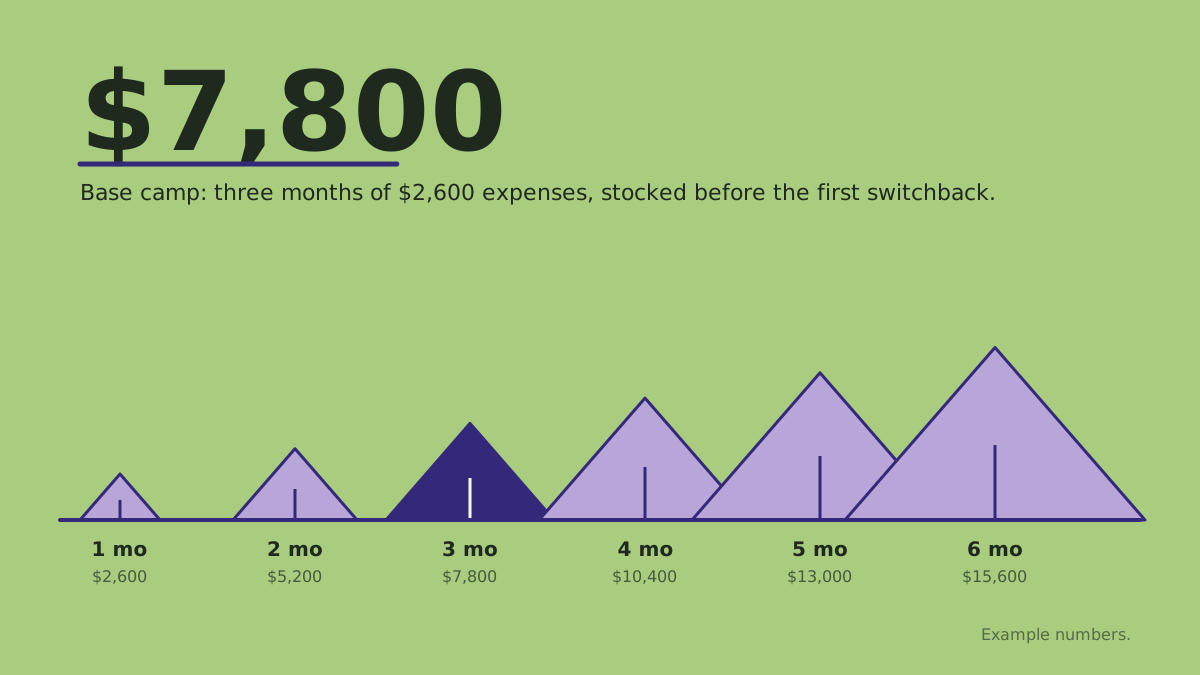
Base camp: $7,800. Three months of $2,600.

How big should the cushion be?

Big enough to cover the ordinary emergencies of your actual life, and no bigger than you can fill in a few months, because a cushion that takes a year to build is just the house fund with a different name.

The clean way to size it is in months of your own expenses. Write down what an ordinary month costs you, everything, then choose how many months of that you want on hand. On the example climb the member's expenses are $2,600 a month and they chose three months, so base camp is $7,800. One month is a thin cushion that covers a repair or two. Six is a thick one that covers a stretch without income. Most people land somewhere between, and the right number depends on how steady your work is, whether there are two incomes or one, and how old the car is.

Whatever you choose, fill it first. Before the first switchback. It's the least exciting part of the whole plan and the part that makes the rest of it survive contact with a Tuesday.

Be honest about how long that takes, because it's the part that makes people skip it. At the example pace of $850 a month, a $7,800 base camp takes a little over nine months to fill. That's nine months before the first switchback clears, and it can feel like nine months of not saving for the house. It isn't. It's nine months of buying the house fund a bodyguard. If nine months is more than you can stand, choose two months of expenses instead, fill it in six, and add the third month later once a few switchbacks are behind you. A smaller cushion you actually build beats a larger one you keep meaning to.

What happens when you use it?

You use it. That's the point. The car needs $650, the $650 comes out, and the cushion reads $7,150 of $7,800. Your climb doesn't move. Your cleared switchbacks stay cleared. Your date holds.

Then your next deposits go back to the cushion until it's full again, and only after that do they resume the switchbacks. That's one month of refilling instead of two months of damage, and, more importantly, the plan never broke. You drew from base camp and stocked it again. That's what base camp is for.

What about after you've bought the place?

Keep it. This is the part people miss. The purchase isn't the end of emergencies; it's the start of a new kind, because a home has more parts that break than a rental and no landlord to call. The cushion you built before the climb is the same cushion that handles the water heater in year one. Don't pour it into the down payment at the last minute to close the gap. If the gap is real, the date moves. That's honest. Emptying base camp to hit a date is a way of starting the next chapter already behind.

On your climb

Base camp is the first stage of every Hill Wallet climb, sized to your own monthly expenses times the months you choose, from one to six. Your deposits fill it before the switchbacks open. When you log a draw, the gauge drops, your climb stays where it was, and the app points your next deposits back at the cushion until it's whole. The home page has a slider that shows the $650 repair both ways, if you'd like to see it rather than read it.

Join Our SMS List

Climb Alerts are account notices, never ads. A reminder on the day you pick, a note when a switchback clears, your sign in code, a renewal notice. Nothing else, ever.

Your phone number is never sold, rented or shared for marketing. It is used only to send the Hill Wallet Climb Alerts you asked for.

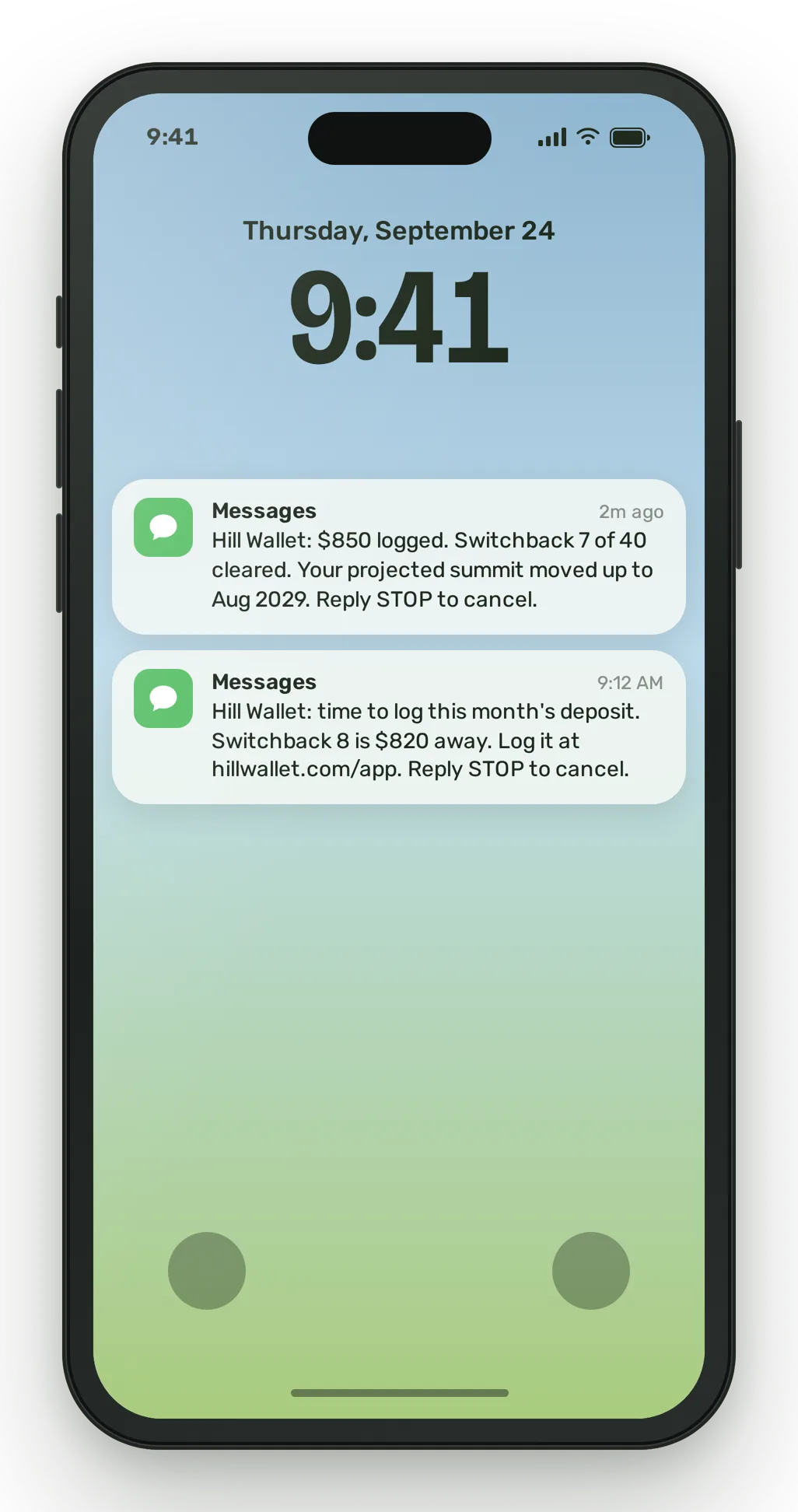
A phone lock screen showing two text notifications from Hill Wallet: one saying $850 was logged and switchback 7 of 40 cleared, one reminding the member to log this month's deposit.
Two Climb Alerts on the example climb.