Guide 01

How much do you actually need for a first home?

The number is three numbers added together. Once you see all three, the total stops being a guess.

5 minute read

Ask the internet how much you need for a first home and it hands you a percentage. Twenty percent. Ten. Three and a half. What it doesn't say is that the percentage is only the first of three numbers, and the other two are what catch people at the end.

Here's the full sum, on an example home, so you can see the shape of it.

What are the three numbers?

The down payment, the closing costs, and the cost of actually moving in. That's the whole list. Add them up and you have your summit, the amount you need in hand before you can stand in an empty living room that's yours.

Take a $260,000 home as the example. Put 10 percent down and the down payment is $26,000. Closing costs, the fees and prepaid items that come due at signing, are often quoted as a small percentage of the price; the example member has budgeted 3 percent, which is $7,800. Moving in, with deposits, a truck, and the first round of things a rental never needed, comes to $2,200 in the example. Add them and you get $36,000.

That's the number. Not $26,000, which is what the percentage told you, and not “somewhere around forty,” which is what your gut said. Thirty six thousand, made of three parts you can each look at on its own.

Why does the percentage matter so much?

Because it's the biggest of the three and the only one you fully choose. On that same $260,000 home, 5 percent down is $13,000, and the summit becomes $13,000 plus $7,800 plus $2,200, which is $23,000. At 20 percent the down payment is $52,000 and the summit is $62,000. Same home, same closing costs, same moving truck, and the total nearly triples between the smallest and largest choices.

How much to put down shapes what comes after, including what you pay each month once you own the place, and that part isn't ours to advise on. What we can say is that the choice is yours to make with open eyes, and it's easier to make when the three numbers sit side by side than when a single percentage floats alone.

If you can't settle the percentage yet, don't. Run the sum twice, once at the lowest percentage you'd consider and once at the highest, and look at the gap between the two summits. On the example home that gap is $39,000, between $23,000 and $62,000, and seeing it written down usually does one of two things. Either it makes the lower percentage feel like the obvious place to start, with the option of putting down more if the saving goes well, or it makes the higher one feel worth the extra years. Both are fine answers. The one to avoid is the vague middle, where you're saving toward “about fifteen percent” and never quite know whether you've arrived.
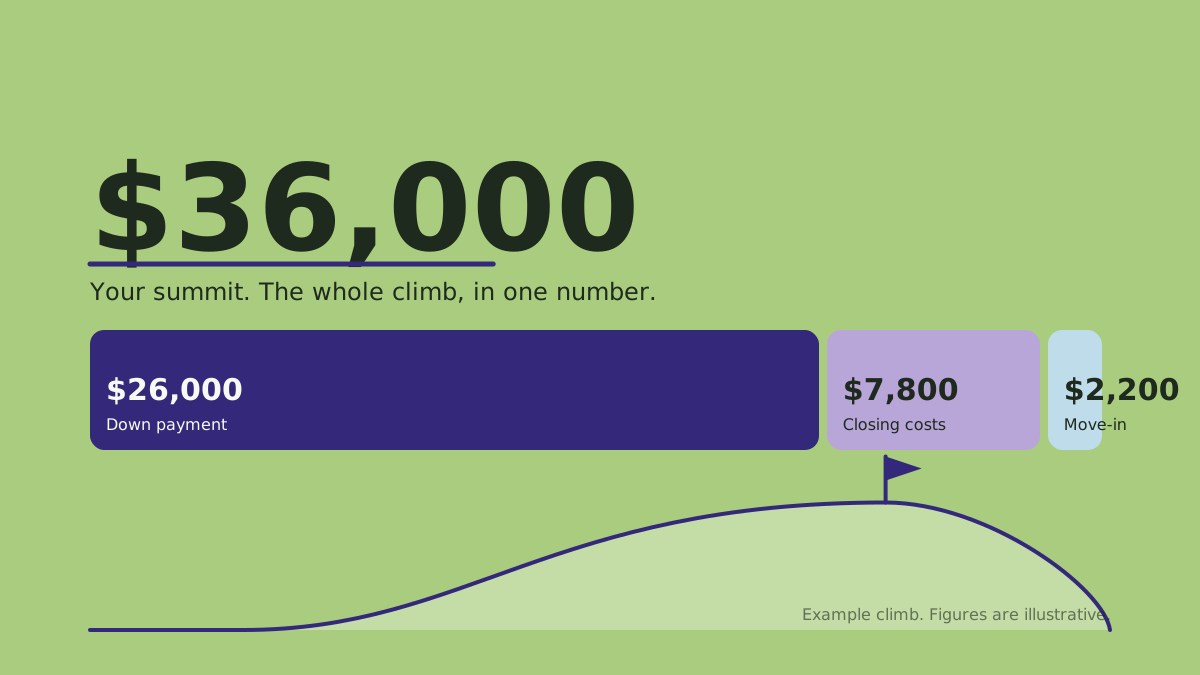

Thirty six thousand, made of three parts you can each look at on its own.

Three blocks proportional to the down payment, closing costs and move in costs joining into one $36,000 summit block
Example climb. Figures are illustrative projections.
Three flat grey stones stacked on a wooden ledge beside a hillside trail

Run the four lines on your numbers

Your summit: $36,000. Projection from your numbers.

Where do closing costs come from?

From your home, your area and your paperwork, which is why no honest planner should supply the figure for you. They're commonly described as a few percent of the price, and they cover things like fees for the people who process the sale, prepaid property taxes and insurance, and a handful of smaller items that vary by state. Early on, you'll only have a rough percentage to work with. That's fine. Put it in, and replace it with a real dollar figure once you have one. The example uses 3 percent because the example member typed 3 percent, not because 3 is right for you.

What does moving in really cost?

More than the truck. People remember the truck. They forget the utility deposits, the week of overlap where you're paying for two places, the curtains a rental had and the house doesn't, the lawnmower, the first grocery run into an empty kitchen, and the small repair the inspection mentioned that you said you'd handle yourself. The example member wrote $2,200 for all of it. Yours might be less if you're moving across town with friends and a borrowed van, or more if you're crossing a state line. Write a number down anyway. A written guess beats an unwritten surprise.

How do you run it on your numbers?

Four lines on the back of an envelope.

Line one, the home price you're aiming for. Not a listing, just the price range you'd be happy in.

Line two, the percentage you plan to put down, turned into dollars. Price times percent.

Line three, closing costs as a percent of the price or a dollar figure you've been given.

Line four, what moving in will cost, itemised if you can bear it.

Add lines two through four. That's your summit. On the example it's $36,000, and if that number makes your stomach drop a little, good. It's supposed to be real. The next question, how you get from here to there, is a different guide, and it turns out to be more answerable than the number suggests.

On your climb

Hill Wallet asks for exactly these numbers when you set up a climb: home price, down payment percent, closing costs, move in costs. It adds them into your summit and never supplies a closing cost figure for you. Change any of the four later and the hill redraws. The planner on this site does the same sum in about a minute, with the example climb already filled in so you can see how it moves.

Join Our SMS List

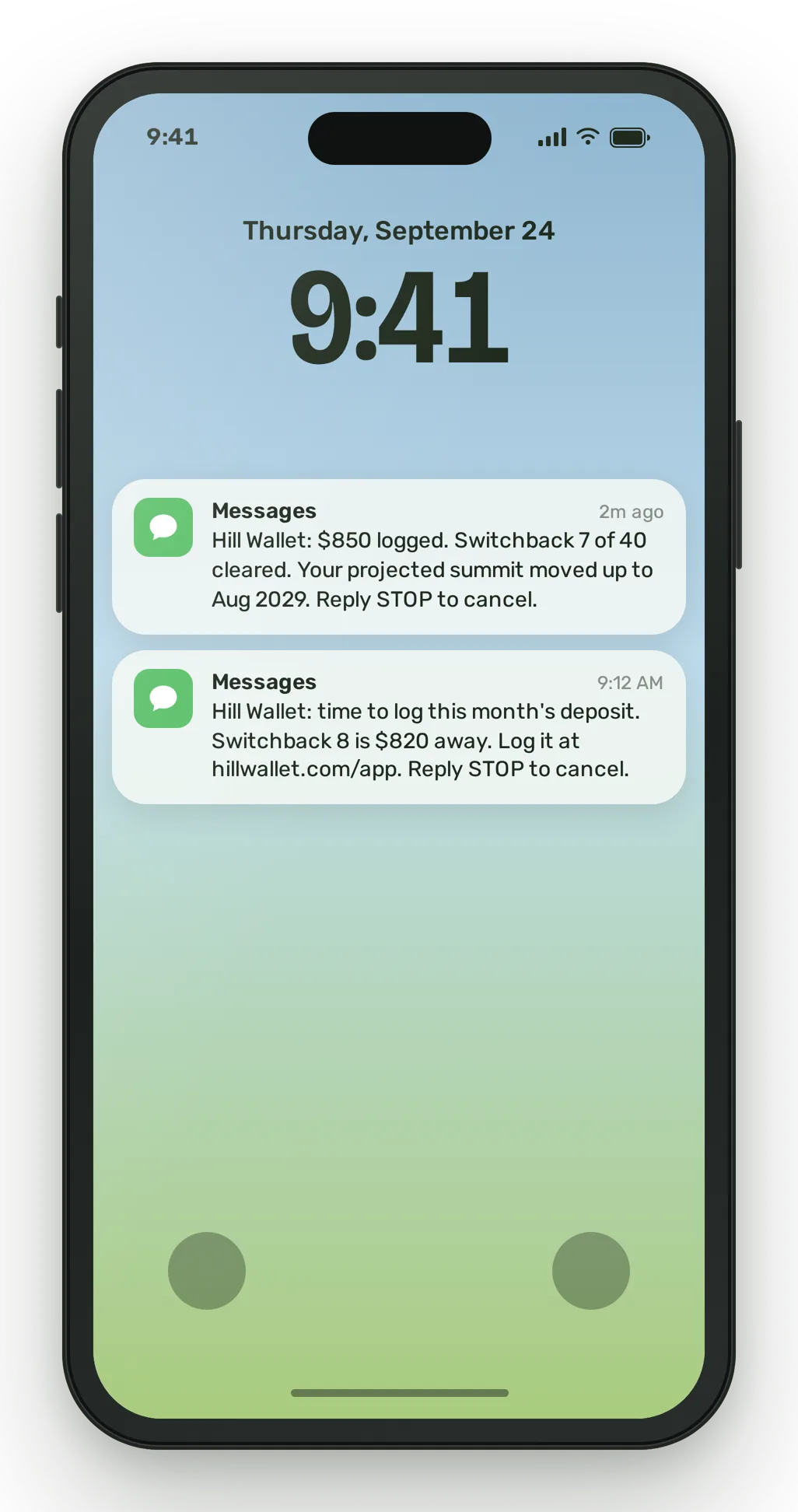
Climb Alerts are account notices, never ads. A reminder on the day you pick, a note when a switchback clears, your sign in code, a renewal notice. Nothing else, ever.

Your phone number is never sold, rented or shared for marketing. It is used only to send the Hill Wallet Climb Alerts you asked for.

A phone lock screen showing two text notifications from Hill Wallet: one saying $850 was logged and switchback 7 of 40 cleared, one reminding the member to log this month's deposit.
Two Climb Alerts on the example climb.