Guide 04

How to pick a monthly amount you'll actually keep

The floor beats the ceiling. How to find yours, and what it does to your summit date.

5 minute read

Most people choose their monthly savings amount on a good day. Payday, maybe, or right after a raise, or in the burst of resolve that follows a look at home prices. They pick the biggest number that seems possible, write it down, and hit it once. Then February has a wedding in it, and the number quietly becomes a suggestion.

The number that gets you to a first home isn't the biggest one you've ever managed. It's the one you can log in an ordinary month, including the ordinary months that go slightly wrong.

What does the amount do to the timeline?

Everything, and it's worth seeing plainly before choosing. Take the $36,000 summit from the example climb on this site, with base camp already stocked.

At $600 a month, that's 60 switchbacks. Five years.

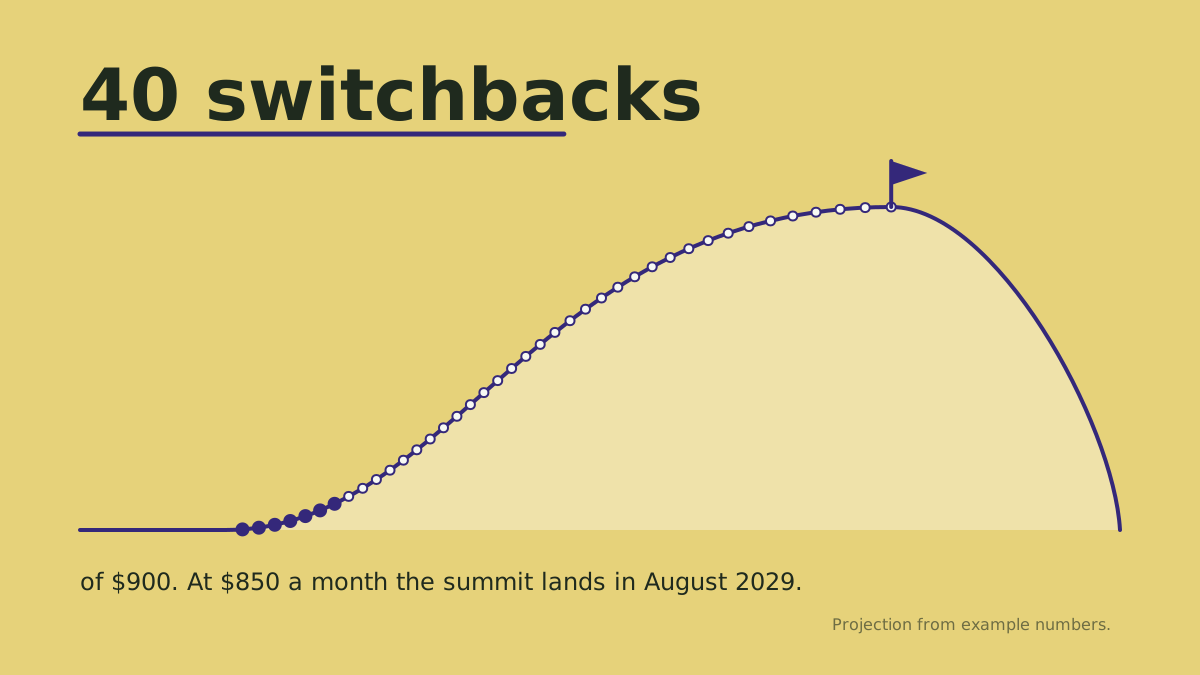
At $900 a month, 40 switchbacks. Three years and four months.

At $1,200 a month, 30 switchbacks. Two and a half years.

Notice that going from $600 to $900 saves twenty months, and going from $900 to $1,200 saves ten. The first few hundred dollars of monthly amount do the most work. That's useful, because it means a modest, kept number moves the date more than an ambitious, broken one, and it means the difference between a good number and a perfect number is smaller than it looks.

One more piece of the timeline, since it's usually left out: the months before the switchbacks. If you're building a cushion first, and you should be, the monthly amount fills that before it touches the summit. The example climb's base camp is $7,800, which at $900 a month is about nine months, so the full trip from an empty account to the summit at that pace is closer to four years than three and a half. That isn't a reason to skip the cushion. It's a reason to count it, so the date you tell yourself is the real one.

How do you find your floor?

Look backward, not forward. Take three ordinary months, not your best three, and work out what actually left your account in each one. Rent, groceries, the bills, the subscriptions you forgot, the things you bought. Then subtract from what came in. The smallest of the three results is close to your floor: the amount that was left over in the leanest of three normal months.

That number will be lower than the one you'd have picked on a good day. That's the point. Pick it anyway, or pick something slightly under it, and treat anything above it as extra rather than as the plan.

Two small adjustments make it stick. Move the money on payday, before the month has a chance to spend it, and log it in the same sitting so the deposit and the record happen together. And decide, ahead of time, what you'll do in a month where even the floor isn't there. The answer is usually “log what I can, including zero, and let the date move.” A plan that has an answer for the bad month is a plan that survives it.

Steady beats heroic, and not for moral reasons. The arithmetic is simply kinder to it.

A trail with three marked paces, $600, $900 and $1,200, and the months each one takes
Example climb. Figures are illustrative projections.
A long dirt trail winding up a grassy hillside in wide bends toward a distant crest

Slide the pace and watch the date

Against the $36,000 example summit, base camp already stocked.

40switchbacks
3 years 4 monthsto the summit
January 2030projected summit. Projection from your numbers.

Why is a kept number better than a bigger one?

Because the pace is what moves the date, and a pace is an average of months you actually did, not a target you once wrote down. On the example climb, the projected summit comes from the last three months of logged deposits divided into what's left. Three months of $850 give a pace of $850 and a date of August 2029. One month of $1,400 followed by two months of nothing gives a pace of about $467, and a date well over a year later, even though the total saved was the same.

Steady beats heroic, and not for moral reasons. The arithmetic is simply kinder to it.

When should you raise it?

When the floor rises, not when your mood does. A raise, a paid off car, a roommate, the end of a subscription you forgot: any of those changes the leanest month, and the leanest month is what sets the number. When it moves, move the amount, and let the date come forward as a result of something real rather than something hoped.

The reverse is also true. If life gets more expensive, lower the amount before you start missing it. A number you keep at $700 is worth more than a number you resent at $900.

What do you actually gain from this?

A date you can trust. When the monthly amount is the floor, the projected summit is a floor too. It can come forward with a good month, but it's unlikely to slip backward from an ordinary one, and that stability is what makes the plan livable across three or four years. You're not reforming yourself. You're just walking at a pace you can hold.

On your climb

Hill Wallet asks for the monthly amount you can log, works out your switchbacks from it, and then reads your real pace from the last three months of deposits rather than from the number you typed. Set the floor and the date will be honest. On Plus, a pace check in tells you each month what it would take to hold your date, and what a little more would do to it, so raising the amount is a decision made with the arithmetic in front of you.

Join Our SMS List

Climb Alerts are account notices, never ads. A reminder on the day you pick, a note when a switchback clears, your sign in code, a renewal notice. Nothing else, ever.

Your phone number is never sold, rented or shared for marketing. It is used only to send the Hill Wallet Climb Alerts you asked for.

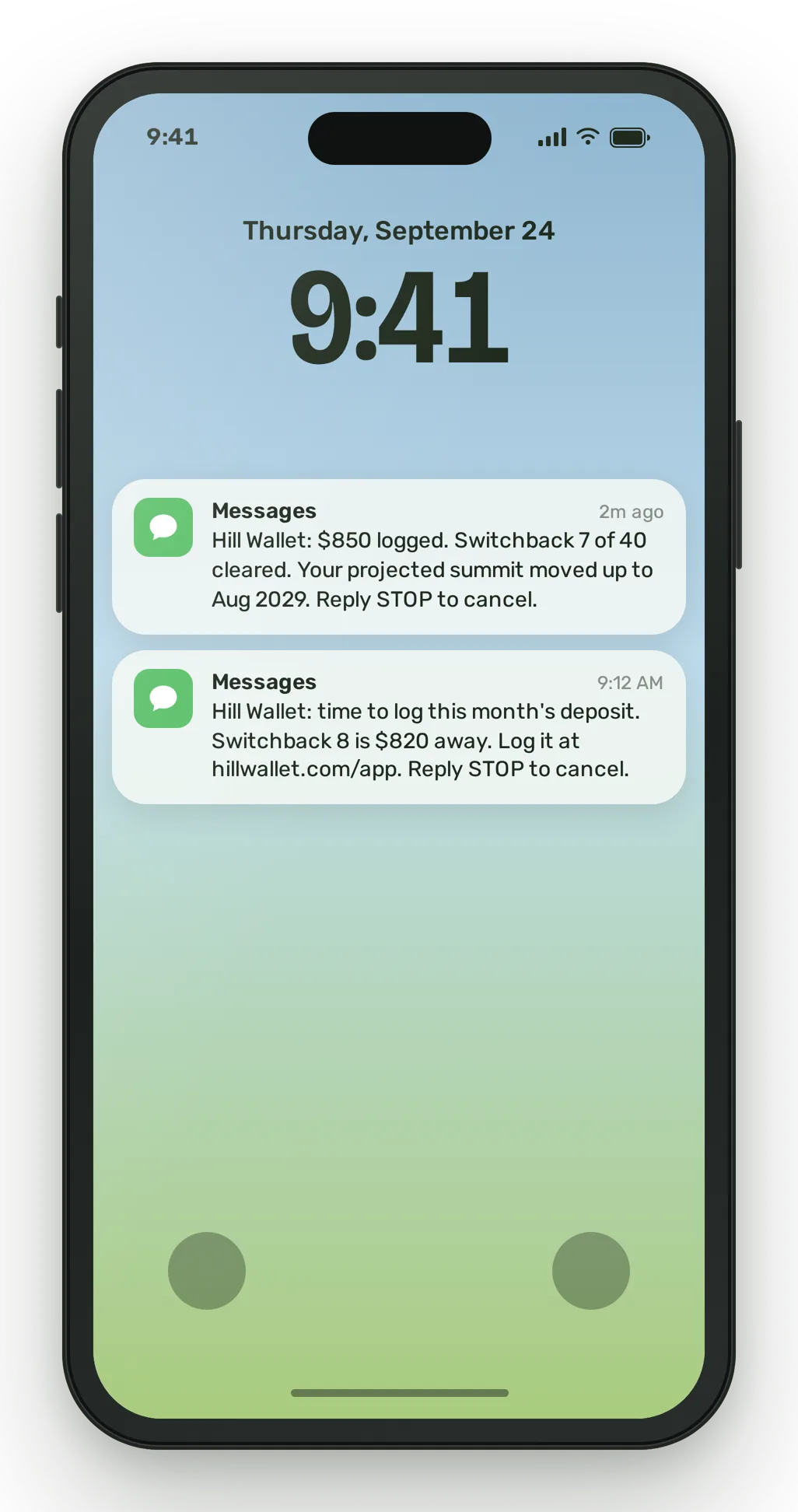
A phone lock screen showing two text notifications from Hill Wallet: one saying $850 was logged and switchback 7 of 40 cleared, one reminding the member to log this month's deposit.
Two Climb Alerts on the example climb.